

Accountability is a Life-Giving Gift: Senior Dinner Remarks from Mr. Roberson
June 13th, 2025
Good evening, Class of 2025, parents, and friends!
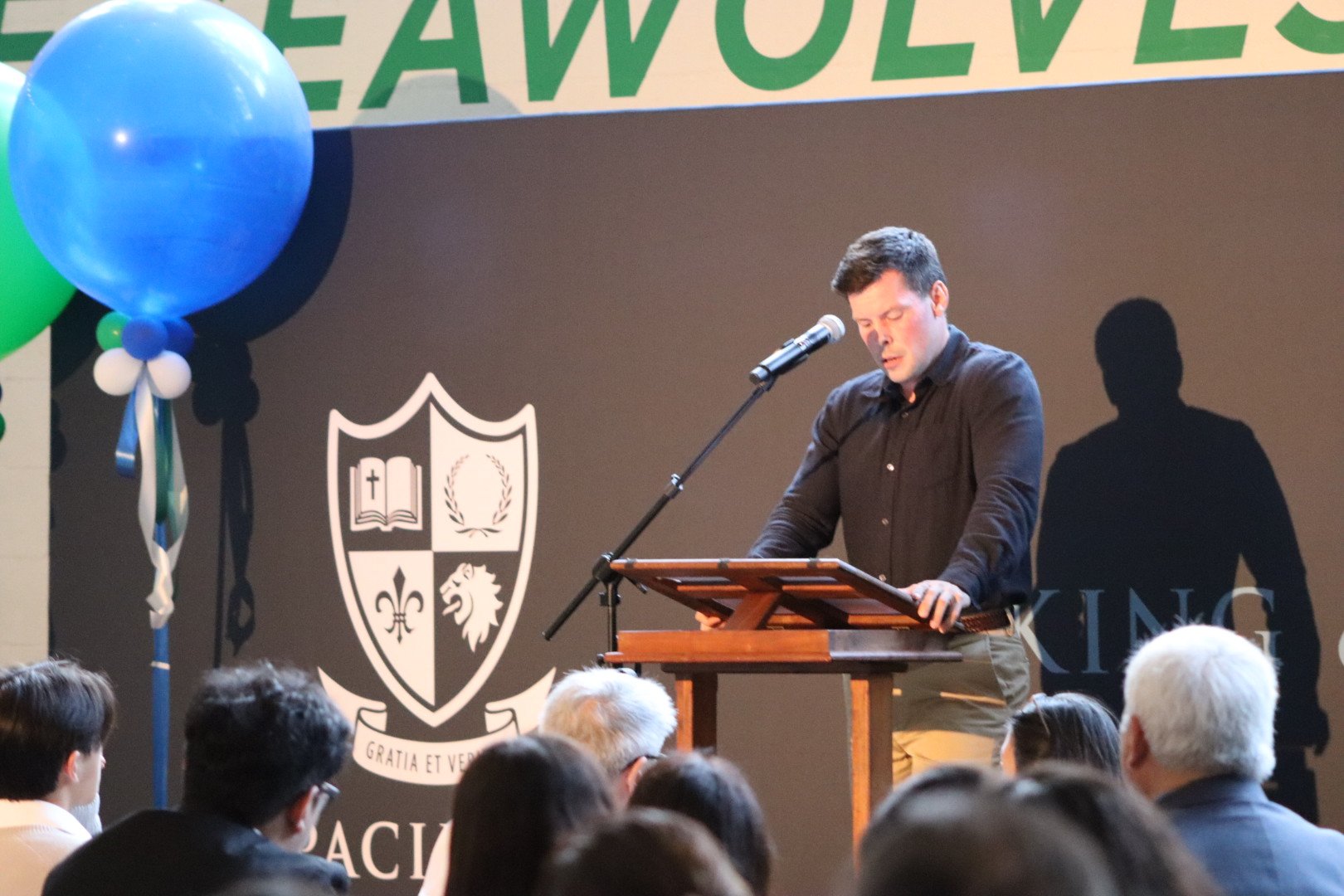
Students, thank you for this honor of letting me speak to you for a few minutes on the eve of your graduation. Admittedly, I was initially at a loss as to what to say for this speech, but I received two great pieces of inspiration that helped me prepare. First, Mr. Streelman reminded me that no one remembers the senior dinner speech, and that freed me up to be a little creative. Second, I found in C.S. Lewis a kindred spirit, for at the beginning of an address to group of graduates, Lewis said: “when you invite a middle-aged moralist to address you, I suppose I must conclude, however unlikely the conclusion seems, that you have a taste for middle-aged moralizing.” So, tonight I will gratify that desire for some middle-aged moralizing with the assurance that you will forget it later.
1. What does “accountability” mean today?
Today there is a lot of talk of accountability. When politicians are found out for providing vast favors to big donors at the expense of the public good, there is an outcry to keep the politician accountable. When a corporate executive is exposed for suppressing safety reports about a defective product—resulting in harm to consumers—there is a demand that they be held accountable. All this is just and right—people should be held accountable for their behavior; yet if this is the only sense we have of accountability, it begins to feel like gravel in our shoes—irritating, punishing, and something we wish to dump out. We picture someone breathing down our necks with a clipboard, eager to pounce when we misstep. Add to all this the ubiquity of social media—one careless sentence can be screenshotted into a “receipt” that outlives the nine lives of your cat—and “accountability” begins to feel less like a virtue and more like a threat.
Tonight, I would like to try to rehabilitate accountability for you. Accountability is not first a subpoena; it is a virtue—a stable habit of mind and heart practiced until it becomes second nature. And like every virtue—courage, justice, generosity—it matures only in relationship. No one becomes brave on a deserted island or honest in a vacuum. We learn courage by standing with friends when fear would make us run, and we learn honesty by telling hard truths to people who could punish us for them.
But since accountability is relational, the key question is: “to whom are we accountable?” I suggest three concentric circles of accountability, the arenas in which we learn accountability— “to others, to the enduring realities of truth, goodness, and beauty, and finally” ….well, you will have to wait and see for the finally.
2. To whom are we accountable?
A. To Others
 The first concentric circle of accountability looks horizontal at the relationships around us. Every “I’ll meet you at seven,” every assurance to finish a group-project, is rehearsal for larger promises.
C. S. Lewis writes, “It is a serious thing to live in a society of possible gods and goddesses, to remember that the dullest and most uninteresting person you talk to may one day be a creature which, if you saw it now, you would be strongly tempted to worship, or else a horror and a corruption such as you now meet, if at all, only in a nightmare. All day long we are, in some degree, helping each other to one or other of these destinations. It is in the light of these overwhelming possibilities, it is with the awe and the circumspection proper to them, that we should conduct all our dealings with one another, all friendships, all loves, all play, all politics. There are no ordinary people. You have never talked to a mere mortal…it is immortals whom we joke with, work with, marry, snub, and exploit— immortal horrors or everlasting splendours. ”
Students, your classmates, colleagues, rivals—even strangers at the Trader Joe’s—carry immortal weight. When we honor deadlines, keep confidences, forgive quickly, and apologize promptly—that is, when we live accountably to others—we create a climate where trust can grow, mistakes can be repaired, and character can ripen.
We are called to be accountable to these fellow immortals, helping one another toward everlasting splendor. If you make accountability a habit, your future workplaces, marriages, and neighborhoods will become places where truth can breathe, and people can flourish. In a word, accountability is good for us and is of great benefit to others.
B. To Truth, Goodness, and Beauty
If the first circle looks horizontal, the second looks vertical. Some truths cannot be bent; some goods must never be betrayed; some beauties demand a reverent pause. Telling the truth when a lie would slide by, choosing fairness when favoritism would pay off, looking up from doom scrolling long enough to let a crimson sunset awe you—each of these acts declare that reality is charged with meaning and that we intend to live in tune with it.
I think of a particular moment from J.R.R. Tolkien’s “The Lord of the Rings”. Frodo and Sam are crawling through the ash of Mordor almost crushed by hopelessness in their quest to destroy the one ring, which could subjugate and ruin all the beauty of their world. At their deepest moment of despair Sam looks up:“There, peeping among the cloud-rack, Sam saw a white star twinkle. The beauty of it smote his heart… and hope returned to him, for the thought pierced him that in the end the Shadow was only a small and passing thing: there was light and high beauty forever beyond its reach.”
That star does not lift the weight of the journey, but it re-calibrates Sam’s moral compass and refreshes him with a transcendent perspective. Likewise, glimpses of truth, goodness, or beauty will not lift the burdens or evils of this life, but they remind us that darkness is temporary and that we are accountable to realities larger than the frustrations, pains, confusions and evils we endure now.
C. To God
Yet, all this talk of accountability to truth, goodness and beauty is slightly deceptive. I said accountability is a relational virtue after all. It seems odd to say that I am accountable to goodness—an abstraction—as odd as it would be to say that I am accountable to “redness” or “roundness”. Abstractions, Plato’s horde of ideals—the forms, and 21st century trivialities are not persons into which I enter into relationship with. So, finally, there is an ancient philosophical tradition that holds that when we consider the One who is the source of all reality the distinction between being, goodness, truth, and beauty breaks down. For God is not just good, but the Good, the Truth, and the Beautiful, and those qualities are embodied for us in the person of Jesus.
For some, the summons to accountability to God conjures the image of a cosmic auditor eager to tally failures. Scripture does speak of judgment, but always within the larger drama of a Father who runs to embrace prodigals. Remember Jesus’ parable: a younger son squanders his inheritance on prostitutes and wild-living, rehearses a groveling apology, and trudges home expecting demotion: from son to servant. Yet before he can stammer a syllable of apology, the father is sprinting down the road, robe flying, arms wide. Accountability here is not humiliation but welcome: the son confronts the truth of his ruin and simultaneously discovers the greater truth of his father’s grace.
To live accountably is to live “coram Deo” — “before the face of God” . And this is both a sobering and liberating reality: sobering because evasion is impossible, liberating because grace is inexhaustible.
3. Conclusion
Class of 2025, tonight you will leave this place, some of you for the last time, and in less than forty-eight hours your status will move from “students” to “alumni.” Yet accountability will travel with you, asking daily:
- Will you keep your word when convenience tempts you otherwise?
- Will you pursue what is true, good, and beautiful when no one will reward you for it?
- Will you live as grateful stewards before the God who entrusts you with breath and purpose?
If you can answer “yes” — imperfectly but sincerely—then whatever titles you earn—doctor, designer, parent, poet—your deepest credential will remain: “trustworthy."
So, raise your glasses, not merely to graduating, but to becoming people who can be counted on—who live accountably. May you step into tomorrow accountable to one another, to enduring realities, and to the One who calls each of you by name.
Thank you, and congratulations!

Categories
Recent Articles
10 Reasons Content Box

10 Reasons to Choose Pacifica
 Inquire
 Apply
Apply Give
Give